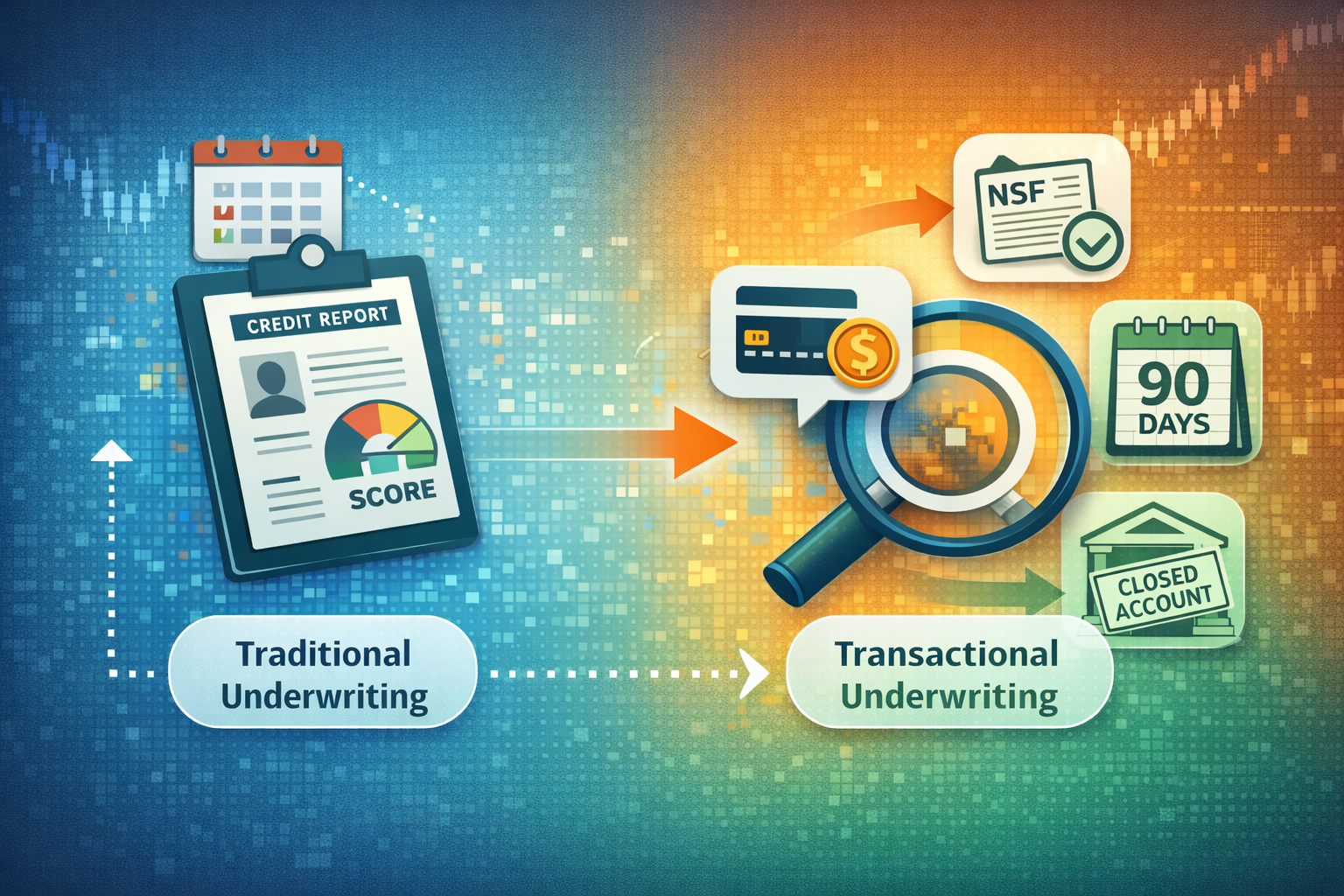
What Is Transactional Underwriting?
Transactional underwriting is a modern way to assess financial risk by looking at current payment behavior, not just past credit history.
Traditional underwriting relies heavily on credit reports and scores. Those tools focus on what happened months or even years ago. Transactional underwriting shifts the focus to what is happening right now—especially around how money is actually moving.
At its core, transactional underwriting evaluates real-world financial activity tied to a specific transaction. It asks a simple question: Is this payment likely to succeed at this moment?
How Transactional Underwriting Works
Instead of treating risk as a static profile, transactional underwriting treats it as situational.
It evaluates factors such as:
Recent payment success or failure
Patterns of returned payments
Timing and frequency of transactions
Signals tied to the payment method itself
These signals are analyzed close to the time a transaction is initiated. That timing matters. Financial
conditions can change quickly, and recent behavior often tells a clearer story than older records.
Why Transactional Signals Matter
A consumer may look acceptable on paper but still show warning signs in their recent activity. For example:
A bank account may appear valid but show recent failed payments
Multiple returns in a short window may point to instability
Certain return types can indicate very low likelihood of success
Transactional underwriting helps surface these risks before a payment or funding decision is finalized.
This approach does not replace traditional credit data. Instead, it adds another layer that captures intent and ability to pay in the present, not just reputation from the past.
How It Differs From Traditional Underwriting
Traditional underwriting is:
Backward-looking
Score-driven
Updated infrequently
Transactional underwriting is:
Real-time or near real-time
Behavior-driven
Tied to a specific payment event
Where traditional models assume past behavior predicts future outcomes, transactional underwriting recognizes that risk changes—sometimes quickly.
Practical Use Cases
Transactional underwriting is commonly used where payment reliability matters most, such as:
Evaluating ACH debits
Final checks before funding
Reducing failed payment attempts
Improving payment routing decisions
Because it focuses on the transaction itself, it can be applied consistently across different consumer profiles and credit histories.
A More Dynamic View of Risk
The biggest shift transactional underwriting brings is mindset.
Risk is no longer treated as a fixed label attached to a person. Instead, it is viewed as a dynamic condition, influenced by timing, behavior, and recent activity.
As payment systems move faster and consumer behavior becomes more fluid, underwriting methods must adapt. Transactional underwriting reflects that reality by meeting risk where it actually shows up—at the transaction.
Key Takeaway
Transactional underwriting evaluates what is happening now, not just what happened before. By focusing on real-time behavior tied to a specific payment, it offers a clearer view of risk at the moment decisions matter most.